

Renewable energy has one stubborn problem. The sun clocks out at night. Wind shows up when it wants. And the grid runs on its own terms, not yours. Battery energy storage systems exist to fix that mismatch, and they’re getting very good at it.
It’s a Lot More Than a Big Battery
Most people picture a massive version of a phone charger. The reality is more layered than that.
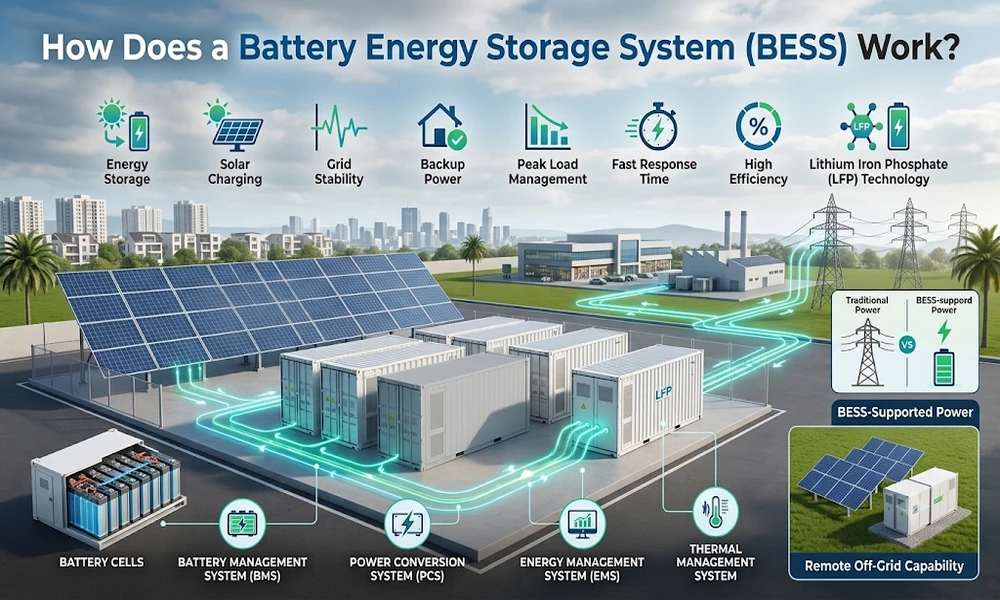
Sure, rechargeable battery cells sit at the core. But what makes a BESS actually reliable is everything built around those cells. A battery management system watches cell health and charge levels constantly. A power conversion system translates between DC power stored in the batteries and the AC power your building and the grid actually run on. An energy management system decides when energy flows in and when it flows out. Thermal management handles heat buildup because large battery systems generate serious heat and unmanaged heat becomes a safety issue fast.
Pull any one of those pieces out, and you don’t have a storage system anymore. You have a problem.
On-Grid, Off-Grid, Wherever You Need It
One thing that doesn’t get said enough about BESS is how flexible the deployment options actually are. These systems work equally well in grid-connected setups and completely off-grid ones.
For remote towns or industrial facilities sitting far from reliable infrastructure, a BESS paired with solar can replace diesel generators outright. Anyone who’s managed diesel costs knows what a genuine relief that is. Expensive, loud, emissions-heavy, and you’re permanently dependent on fuel supply chains.
For commercial and urban users, the picture looks different but equally valuable. You draw from stored power during peak tariff hours instead of paying grid rates. You stay operational during outages. Large operators can even earn revenue through grid frequency regulation services. And increasingly, residential BESS installations are giving homeowners the same advantages at a smaller scale, cutting dependence on the grid without giving up reliability. The throughline across all of it is control over when and how you use grid power.
What Actually Drives Performance
Four factors determine how well a BESS performs in practice: response time, round-trip efficiency, energy retention, and battery chemistry. Lithium iron phosphate (LFP) has become the dominant chemistry for commercial and utility applications. Better thermal stability, longer cycle life, and a safer operating profile than older lead-acid alternatives make it the default choice for most serious deployments.
Battery costs have also dropped significantly over the past few years, which is why adoption is accelerating fast across India.
With an increasing number of energy storage systems, Waaree is making an effort to diversify into areas other than solar power production. This company has already reached an installed solar module manufacturing capacity of more than 25.8 GW, recently inaugurated a 10 MWh BESS system in Tamil Nadu, and is set to ramp up the manufacturing of lithium-ion batteries and BESSs to 20 GWh.