

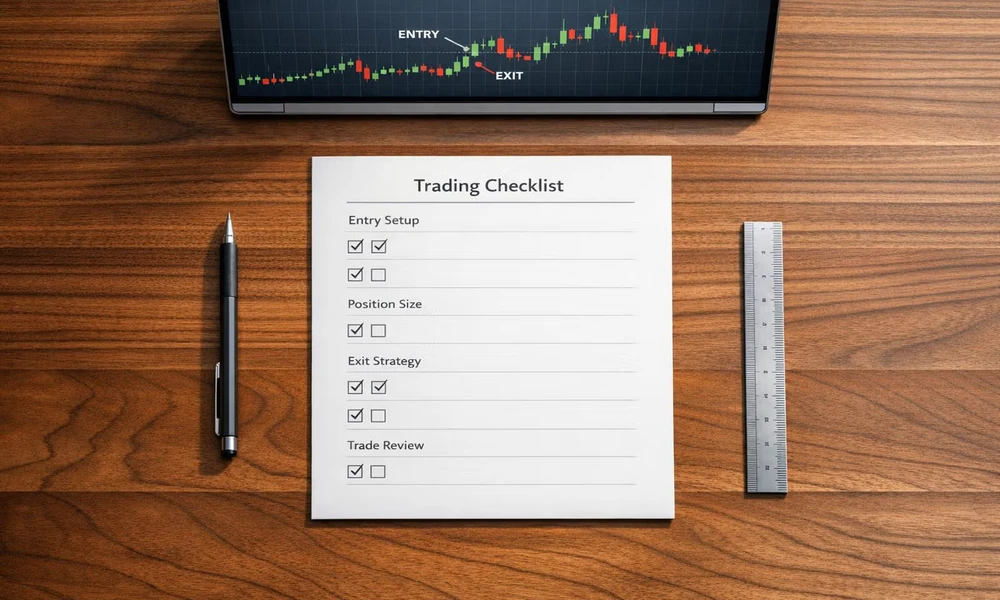
Before users Trade, they should understand that market access alone does not create a reliable decision process. A platform may provide live prices, charts, alerts, and fast order placement, but these tools cannot determine whether a position is suitable.
A better approach begins with preparation. Users should define the purpose of the position, decide how much capital can be exposed, review the product, calculate costs, understand order types, and set clear exit conditions.
The following checklist can help users assess whether they are ready to participate with greater control and fewer avoidable mistakes.
The Reason Behind the Position Comes First
Every market position should have a clear objective.
Possible purposes include:
- Long-term ownership
- Short-term price participation
- Portfolio rebalancing
- Hedging
- Income-focused strategies
- Event-based positioning
The objective affects the research method, holding period, position size, and exit rule.
A short-term position should not automatically become a long-term holding after the price declines. Similarly, a long-term investment should not be sold only because of normal daily volatility.
The purpose should be written before entry.
Essential Savings Should Never Fund Market Risk
Money used for market activity should remain separate from essential savings.
Funds required for the following should not be exposed:
- Rent
- Medical expenses
- Education
- Insurance
- Loan repayments
- Emergency needs
A user who invests essential money may be forced to exit at an unfavourable time.
The amount allocated should remain affordable even if the position declines significantly.
Borrowing for speculative activity can create additional pressure because the repayment remains fixed.
Know the Product Before Committing Capital
Different market products behave differently.
These may include:
- Shares
- Exchange-traded funds
- Futures
- Options
- Bonds
- Commodities
Each product may have different:
- Risk levels
- Settlement rules
- Charges
- Liquidity
- Leverage
- Tax treatment
Users should not activate or use a product only because it is available on the platform.
The product should be understood before any capital is committed.
Research Requirements Change With the Asset Type
For shares, users should review:
- Business model
- Revenue
- Profitability
- Cash flow
- Debt
- Management quality
- Valuation
- Industry conditions
For derivatives, users may also need to understand expiry, lot size, margin, volatility, and settlement.
For funds, benchmark, expense ratio, portfolio concentration, and tracking quality may be relevant.
The research process should match the product.
Liquidity Determines the Ease of Entry and Exit
Liquidity affects how easily an order can be completed.
Users should check:
- Bid price
- Ask price
- Bid-ask spread
- Trading volume
- Market depth
- Recent activity
Low liquidity may result in:
- Wider spreads
- Delayed execution
- Partial completion
- Slippage
- Difficulty exiting
A fast-moving price does not confirm that sufficient buyers or sellers are available.
Position Size Should Reflect the Loss You Can Absorb
Position size should be based on the acceptable loss rather than the total account balance.
The user can consider:
- Total capital
- Maximum loss per position
- Volatility
- Distance to exit level
- Existing exposure
- Sector concentration
A position that is too large may create emotional pressure and make it harder to follow the original plan.
A smaller allocation can help beginners understand market behaviour without exposing a large portion of capital.
Draw the Loss Boundary Before Trading Begins
A predefined loss limit can protect the wider account.
Limits may be set as:
- A fixed amount
- A percentage of capital
- A maximum daily loss
- A maximum number of losing positions
- A maximum drawdown
Once the limit is reached, further activity should stop.
Trying to recover a loss immediately may lead to larger positions, weaker decisions, and repeated mistakes.
Market, Limit or Stop: Choose the Instruction Carefully
Different instructions affect execution.
Market Order
A market order attempts to complete at the best available price. The final rate may differ during volatile conditions.
Limit Order
A limit order allows the user to define an acceptable price. It may remain pending if the market does not reach that level.
Stop Order
A stop order becomes active after a selected trigger is reached. Exact execution is not guaranteed.
Users should understand how each order behaves before submitting it.
A Few Seconds of Verification Can Prevent Major Errors
Before confirmation, users should verify:
- Security name
- Exchange
- Buy or sell direction
- Quantity
- Order type
- Entered price
- Product category
- Available funds
A small input error can result in a much larger transaction than intended.
The confirmation screen should be reviewed even when prices are moving quickly.
Submission, Execution and Completion Are Not the Same
A submitted order may be:
- Pending
- Fully executed
- Partially executed
- Rejected
- Cancelled
- Modified
Users should not assume that submission means completion.
The order book and trade book should be reviewed separately.
If only part of the quantity has executed, the remaining order may need to be modified or cancelled.
The Real Transaction Cost Extends Beyond Price
The visible price is not the only cost.
Possible expenses include:
- Brokerage
- Exchange transaction charges
- Securities transaction tax
- Goods and services tax
- Stamp duty
- Depository charges
- Bid-ask spread
- Funding costs where applicable
Frequent activity can significantly increase total expenses.
Users should calculate performance after all entry and exit costs.
Consistency Starts With a Repeatable Market Routine
A structured routine can reduce impulsive action.
The routine may include:
- Reviewing major announcements
- Checking economic events
- Updating watchlists
- Marking key price levels
- Confirming available funds
- Defining maximum risk
- Reviewing existing positions
The goal is not to predict every movement.
It is to begin with a clear plan rather than react to every alert.
Two Market Approaches Need Two Separate Plans
A Trading Market position may require short-duration monitoring, execution control, and strict risk limits.
Long-term investing usually focuses more on business quality, asset allocation, and financial goals.
Mixing the two can make performance and risk difficult to understand.
Separate capital, records, and review rules can help users maintain discipline.
Headlines Do Not Always Demand a Transaction
Market prices may respond to:
- Company announcements
- Economic data
- Global events
- Regulation
- Interest rates
- Currency movement
Not every development requires a transaction.
Users should focus on information that materially affects the company, product, or original setup.
Unverified social media claims should not replace official disclosures.
Loss Recovery Should Never Become the Next Strategy
Revenge trading occurs when users place another position mainly to recover a loss.
Warning signs include:
- Increasing quantity after a loss
- Entering without research
- Ignoring exit rules
- Placing repeated rapid orders
- Moving loss limits continuously
A structured pause can help users review what went wrong.
The next position should be taken only when it meets the same standards as the original plan.
Let the Trading Journal Reveal Process Weaknesses
A transaction journal may include:
- Date and time
- Product
- Entry price
- Quantity
- Reason for entry
- Maximum risk
- Exit condition
- Final result
- Charges
- Mistakes
The journal can reveal recurring problems such as late entries, excessive size, weak exits, or unnecessary activity.
Performance should be reviewed by process quality, not only by profit.
Leverage Changes Both Exposure and Loss Potential
Margin can increase exposure beyond the cash available.
Users should understand:
- Initial margin
- Maintenance requirement
- Funding cost
- Additional margin calls
- Forced closure conditions
- Maximum potential loss
A leveraged position can move against the user quickly.
Maintaining only the minimum margin may create problems during sudden volatility.
Strong Account Protection Belongs in Every Market Plan
Financial accounts should use:
- Two-factor authentication
- Biometric login
- Device verification
- Login alerts
- Session timeout
- Transaction notifications
Passwords and one-time codes should never be shared.
Users should avoid unknown links, unofficial support contacts, and remote-access requests.
Applications should be downloaded only from verified sources.
End-of-Session Checks for Orders and Exposure
Before the session ends, users should check:
- Which positions remain active
- Whether any order is pending
- Whether stop instructions are active
- Whether sufficient margin remains
- Whether overnight exposure is intended
- Whether expiry or settlement is approaching
An unintentional open position can create additional risk.
Order closure should always be confirmed.
Decide How the Position Ends Before It Starts
An exit plan may include:
- Profit objective
- Maximum loss
- Time-based closure
- Event-based review
- Valuation change
- Thesis failure
- Expiry requirement
The exit should match the original purpose.
Changing the rule repeatedly after losses begin can increase account damage.
Reliable Execution Matters More During Market Stress
A platform should provide:
- Accurate prices
- Timely order updates
- Clear rejection messages
- Stable login
- Downloadable statements
- Alternative access
- Customer support
No application can guarantee uninterrupted service.
Users should know how to manage open exposure if the primary interface becomes temporarily unavailable.
Preserve Transaction Evidence Beyond the Live Dashboard
Important records include:
- Contract notes
- Ledger statements
- Holding statements
- Profit and loss reports
- Charge summaries
- Tax records
These documents support reconciliation, tax filing, and complaint resolution.
Users should preserve them independently rather than relying only on the live dashboard.
Judge the Process Separately From the Outcome
A profitable result does not always mean the process was good.
A disciplined position can also produce a loss.
Performance should be reviewed using:
- Rule adherence
- Average gain
- Average loss
- Maximum drawdown
- Costs
- Position size consistency
- Avoidable errors
This helps users improve the process rather than judge decisions only by one outcome.
Final Tool Comparison
Before selecting a Mutual Fund Sip App, users should determine whether they need long-term contribution automation, goal tracking, scheme comparison, asset allocation, and periodic review instead of active market execution tools.
The platform should match the user’s actual financial activity.
A product designed for goal-based investing should not be evaluated by the same standards as a platform built for short-duration transactions.
Conclusion
Users should complete a clear readiness checklist before they Trade.
The process should cover product understanding, research, liquidity, position size, costs, order checks, risk limits, security, and exit planning. Separate capital should be maintained for long-term goals and active market activity.
A disciplined framework cannot remove market uncertainty, but it can reduce avoidable errors caused by haste, excessive exposure, poor preparation, or emotional decisions.
Frequently Asked Questions
1. How much capital should beginners use?
They should start with an amount that can be exposed without affecting essential expenses, emergency savings, or debt repayments.
2. Why is position sizing important?
It limits the effect of one incorrect decision on the total account.
3. Should users place another transaction immediately after a loss?
Not automatically. They should first review the cause and wait for a valid setup.
4. Are market orders suitable for every product?
No. They may produce unexpected prices when liquidity is weak or volatility is high.
5. What should a transaction journal contain?
It should include the reason, entry, quantity, risk, exit, charges, result, and lessons from each position.